Expressions vs equations
Expressions don’t contain an equals, whereas equations do have an equals sign.
Rearranging inequalities
When rearranging inequality equations, care must be taken regarding whether the sign stays the same or reverses. Adding or subtracting the same value from both sides; sign stays the same. When multiplying or dividing each side by the same positive number; sign stays the same. However, if we multiply or divide each side by the same NEGATIVE number then the sign reverses. Obviously, if you flip the sides, then the sign needs to get flipped too. Consider the following equations:$$-5x<-20$$$$\frac{-5x}{-5}>\frac{-20}{-5}$$$$x>4$$The first step we divide each side by -5, therefore the sign gets reversed. In the second step, the sign stays the same and we are just doing the maths.$$7\ge 3-x$$$$7-3\ge-x$$$$4\ge-x$$$$-4\le x$$In this example, the sign in the first step is maintained as we minus 3 from each side. In the last step we are multiplying each side by -1, which means the sign must be reversed.$$\frac{y}{-9}<2$$$$y>-18$$Here we multiplying each side by -9 so the sign reverses.$$x – 5 > 10$$$$x > 15$$In this example, we are simply adding 5 to each side; sign stays the same.
Graphs
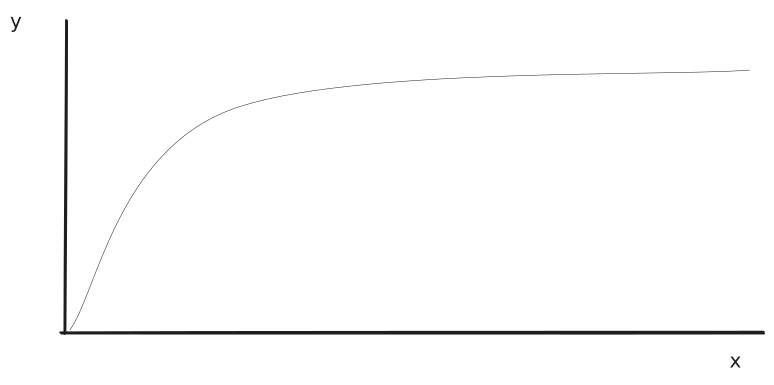
Equations in the form $y=a\sqrt{x}$ where a is positive, results in a concave down graph, or a diminishing return graph (in real world application):
To work out where a graph will intercept the y axis, substitute x for 0. Conversely, to find out where the graph crosses the x axis, substitute y for 0
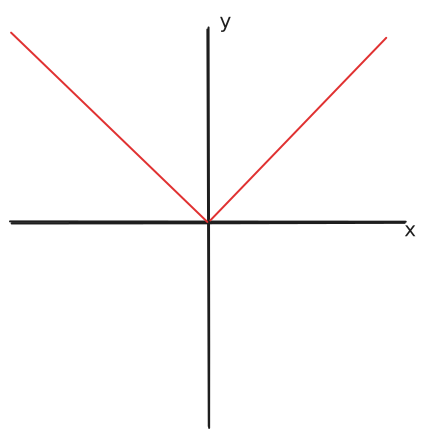
The absolute value of a number is how far away from zero it is. it is written:$$|x|$$So…$$|3| = 3$$$$|-10| = 10$$The answer is never negative. When graphed, the line will never be in the negative, unless it is translated. So $y=|x|$ will look like:
It helps to be able to visualise graphs by looking at the equation:
$y=x$ is an upward sloping straight line
$y=-x$ is a downward sloping straight line
$y=4$ straight horizontal line intersecting $y$ at 4
$x=4$ straight vertical line intersecting $x$ at 4
$y=x-a$ like the $y=x$ graph but translated down $a$ spaces.
$y=x^2$ a smile/a U shape curve/a parabola
$y=2x^2$ a steeper curve than above
$y=0.5x^2$ a shallower curve than above
$y=x^2+2$ parabola moves up 2
$y=(x+2)^2$ parabola moves left by 2
$y=(x-2)^2$ parabola moves right by 2
$y=-x^2$ upside down smile
$x^2+y^2=25$ circle with radius 5
The vertex is the highest or lowest point in a graph.
$y=x^2$ vertex is at 0,0
$y=x^2+2$ vertex is at 0,2
$y=(x-2)^2+2$ vertex is at 2,2
To signify rounding up and down we use the following notation:
$\lfloor x \rfloor$ to round down and $\lceil x \rceil$ to round up
When we graph $y=\lfloor x \rfloor$ we get:
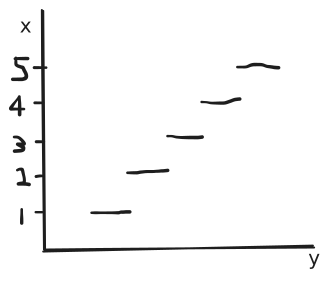
There are no decimal solutions for $y$. It gives a floor function, or step function.
Polygons, shapes and angles
All exterior angles in a polygon add up to $360^\circ$. The sum of all interior angle of any $n$ sided polygon (or n-gon) is $$180^\circ \times (n-2)$$
Triangle: $180\times(3-2) = 180$
Square: $180\times(4-2) = 360$
Pentagon: $180\times(5-2)=540$
Hexagon: $180\times(6-2) = 720$
To find one interior angle of any regular (meaning all angles are the same) polygon, divide the above equation by $n$; $$\frac{180\times(n-2)}{n}$$
Triangle: $\frac{180\times(3-2)}{3}=60$
Square: $\frac{180\times(4-2)}{4}=90$
Pentagon: $\frac{180\times(5-2)}{5}=108$
Hexagon: $\frac{180\times(6-2)}{6}=120$
Decagon: $\frac{180\times(10-2)}{10}=144$
Opposite angle are equal:
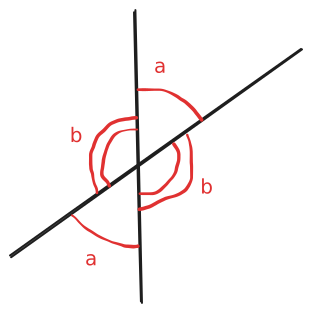
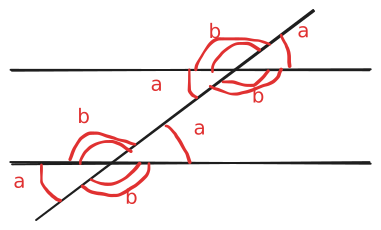
This is also true for a straight line intersecting 2 parallel lines:
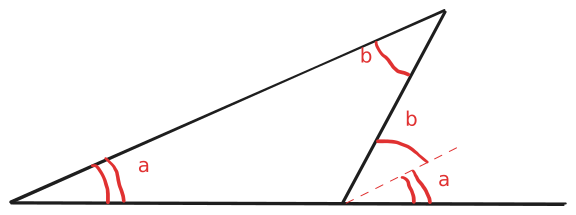
The measure of a triangle’s exterior angle is the sum of the 2 opposite angles:
In a scalene triangle, the side opposite the smallest angle is the smallest side. The angle opposite the longest side is the largest angle.
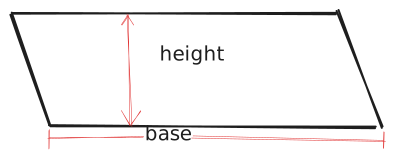
Circumference of a circle with diameter $d$ is:$$C=\pi d$$Area of a circle with radius $r$ is:$$A=\pi r^2$$or:$$A=\frac{1}{2} r C$$Arc length with angle $a$ and diameter $d$ is:$$arc length =\frac{a}{360} (\pi d)$$A parallelogram’s area is the same as that of a rectangle:$$base \times height$$
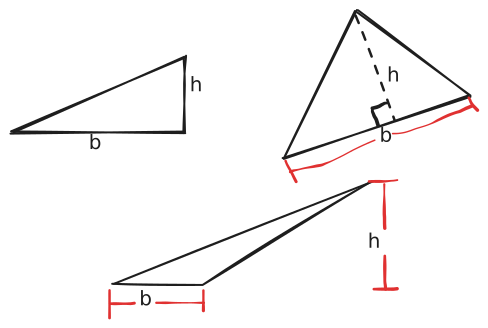
Triangle’s area is always:$$\frac{1}{2}base \times height$$
To find the area of any regular n-gon we can split it into $n$ number of triangles.
In a regular polygon, a line segment from it’s centre that is perpendicular to a side is called an apothem.
If a regular polygon’s apothem is $a$ and it’s perimeter is $P$ then it’s area is:$$A=\frac{1}{2}ap$$The diagonal length of a square of side $x$ is$$x\sqrt2$$
therefore the hypotenuse of a right angle isosceles triangle whose 2 equal sides are $x$ is also $x\sqrt 2$.
In an equilateral triangle with side length 2, the height is $\sqrt 3$ and the area is also $\sqrt 3$.
In any right angled triangle with other angles of 30 and 60, the side lengths opposite are:$$30:x, 60: x\sqrt3, 90: 2x$$Scaling any shape proportionally by a factor of $s$ scales the area by a factor of $s^2$ and the volume by $s^3$.
Surface area of a pyramid of base area $B$, base perimeter $P$, slant height $s$, $n$ sides and $L$ length of one base side is:$$B+\frac{1}{2}Ps\quad or\quad B+n(\frac{1}{2}Ls)$$Thus a cone’s surface area:$$B=\pi r^2 \quad P=\pi D \quad therefore: \quad \pi r^2 + \frac{1}{2} \pi Ds$$Every pyramid’s volume is $\frac{1}{3}$ the volume of a prism with the same base and height.
The volume of a pyramid with base area $B$ is:$$V=\frac{1}{3}Bh$$A circle’s area inside a square where the $diameter = side$ is always $\frac{\pi}{4}$ the area of the square. Thus a cylinder’s volume is $\frac{\pi}{4}$ that of a cube.
Volume of a sphere:$$V=\frac{4}{3}\pi r^3$$Surface area of a sphere: $$SA=4\pi r^2$$Volume of a cone:$$V=\frac{1}{3} h \pi r^2$$