A vector describes a shift in space. It is represented by:
$$\vec{v}$$
Points (or locations) are represented by round brackets like on a normal $(x, y)$ graph. Vector moves are represented in angle brackets $<a,b>$.
$$\vec{v} = <k,j>$$
Suppose $\vec{v}$ and $\vec{w}$ have their tails in the same place. Subtracting $\vec{w} – \vec{v}$ gives us the vector from the head of $\vec{v}$ to the head of $\vec{w}$.
$$\vec{v}+\vec{z}=\vec{w} \quad \vec{z}=\vec{w}-\vec{v}$$
We use $|\vec{v}|$ to denote the length of $\vec{v}$.
When vectors $<a,b>$ and $<x,y>$ have their tales in the same position, the distance between their heads is:
$$|\vec{d}|=\sqrt{(x-a)^2+(y-b)^2}\quad Pythagoras!$$
To scale a vector we multiply both components by the scalar. When we scale a vector, the direction is the same but the length is changed (if scaling by a positive scalar, if scaling by a negative scalar then the direction reverses).
A vector whose head is halfway between the head of $<x,y>$ and $<a,b>$ is the average of each pair of components:
$$\langle\frac{x+a}{2},\frac{y+b}{2}\rangle$$
Vector transformations:
To translate we add the same vector to each component: $\vec{result}=\vec{orig}+{trans}$
$orig= <2,3>$ $trans=<1,2>$ $result=<3,5>$
To scale, we multiply the vector by the scalar
$\vec{R}=k\vec{O} \quad 2\times <2,3>=<4,6>$
To reflect over the $x$ axis we negate the $y$ value
To reflect over the $y$ axis we negate the $x$ value
To reflect over $x=y$ line we perform $x=y$ to each component (basically swapping $x$ and $y$. We can also reflect along any straight line, example: $y=2x+3$.
On a right angled triangle with one angle of $30^\circ$, the opposite side is half of the hypotenuse.
When working out how much to rotate vectors, we can use a polar graph (a radial graph with 0,0 at the centre). Here we use the angle $\theta$ (a line with an angle value of 0 is a straight line along the $x$ axis, starting at 0,0. A line with an angle value of 90 is a straight line along the $y$ axis starting at 0,0) and the distance $d$ from the origin; $(\theta, d)$. Since the graph is circular, the distance from the origin is it’s radius, so; $(\theta, r)$.
The point on a polar graph can be represented as a right angle triangle with sides $x$, $y$ and $r$ with angle $\theta$ at the origin.
The direction of a vector determines the values of $\frac{y}{r}$ and $\frac{x}{r}$. As the angle changes, so does the $x$ and $y$ components and therefore the values above too. These fractions are the ratio of the component compared to the radius. When $\frac{y}{r}=1$, $y$ and $r$ are equal therefore vector facing up. When $\frac{x}{r}=1$, $x$ and $r$ are equal therefore vector facing right.
The ratio $\frac{x}{r}$ is called the cosine of the vector’s angle.
$$cos\theta = \frac{x}{r}$$
Example:
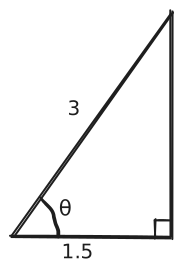
$$cos60=\frac{1.5}{3}=0.5$$
Therefore when a vector’s direction is 60$^\circ$, the ratio $\frac{x}{r}$ is equal to 0.5.
Every angle from 0 to 90 has a cosine somewhere between 1 and 0.
Looking at $cos\theta = \frac{x}{r}$ also $x=r cos\theta$, $x$ is the horizontal component so to find the horizontal component, we multiply the radius by the cosine of the angle $\theta$.
The ratio $\frac{y}{r}$ is called the sine of the vector’s angle.
$$sin\theta = \frac{y}{r}$$
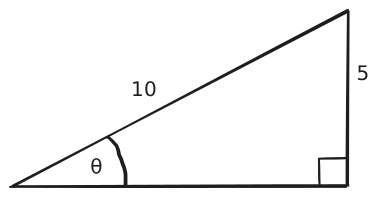
$$sin30=\frac{5}{10}=0.5$$
Therefore when a vector’s direction is 30$^\circ$, the ratio $\frac{y}{r}$ is equal to 0.5.
Every angle from 0 to 90 has a sine somewhere between 0 and 1.
Looking at $sin\theta = \frac{y}{r}$ also $y=r sin\theta$, $y$ is the vertical component so to find the vertical component, we multiply the radius by the sine of the angle $\theta$.
NB: Cosine for the horizontal component $x$, sine for the vertical component $y$ or…
$$<rcos\theta , r sin \theta>$$
When a vector $<x,y>$ is rotated by an angle $\theta$ the resulting vector is:
$$<x\,cos\theta-y\,sin\theta \, , \, x\, sin\theta+y \, cos\theta>$$
The Dot Product, written as $\vec{k} \cdot \vec{b}$ is the outcome of multiplying $|\vec{b}|$ by the component of $\vec{k}$ that’s in the same direction as $\vec{b}$. Another way of looking at the dot product is:
$$ \vec{b} \cdot \vec{k}= |\vec{b}| \times kx$$
The direction of the vector $b$ multiplied by the $x$ component of $k$.
For any 2 vectors $\vec{a}$ and $\vec{b}$ the dot product is:
$$ \vec{a} \cdot \vec{b} = |\vec{a}| \, |\vec{b}|\,cos\theta$$
where $|\vec{a}|$ and $|\vec{b}|$ are the lengths of the vectors and $\theta$ is the angle between them.
This can be re-written as:
$$\,cos\theta=\frac{\vec{a} \cdot \vec{b}}{|\vec{a}| \, |\vec{b}|}$$
The dot product equals 0 when the vectors are perpendicular.
When the dot product is positive, the angle is less than 90.
When the dot product is negative, the angle is greater than 90.
When the dot product is -1, the vectors are opposing.
We can calculate the dot product from $x$ and $y$ components too:
$$ \vec{k} \cdot \vec{b} = kx\,bx+ky\,by$$
We can use this formula to ascertain the angle if it is unknown or if the vectors are perpendicular or if they are nearly pointing in the same direction (approaching 1).